In 2026, USA Triathlon connects with and supports more than 300,000 active members each year, with the 20–29 age bracket growing nearly 20% in 2025 alone — two-thirds of them new to the sport (USA Triathlon — 2025 Impact Report). The sport has never been more popular. And if one thing unites us all, it's that creeping stress the night before: did I remember the...?
This triathlon checklist is built so you never have to ask that question again. Three disciplines, two transitions, the gear and rules required by World Triathlon, the tweaks by distance and weather, and the timing to follow from the night before to the start line. Everything you need to get on course calm and focused on the race — not wondering whether you forgot something.
“At Ironman Nice, I had so much on my mind that I left my race belt at home” — Flo
Why a triathlon checklist changes everything
Triathlon isn't a sport you wing. Three disciplines back to back, two timed transitions, and gear counted in dozens of items. On top of that, most of the time the race is nowhere near home — another city, often another country. That demands surgical, well-rehearsed logistics so nothing gets left behind.
USA Triathlon hit a new milestone in 2026 with more than 300,000 active members, a steady climb driven by a 20–29 bracket that grew nearly 20% in a single year — and two-thirds of those new arrivals were brand-new to the sport. That popularity means two things: more beginners on the start line (for many, it's their first sprint triathlon), and more races where someone discovers, sometimes too late, that they forgot something essential.
The night before at 10 pm is the worst possible moment to ask yourself “did I pack my swim goggles?”. You're tired, you need to sleep, you have no patience left for rifling through drawers. That's exactly what a checklist is for: write the exhaustive list once, in order, and tick boxes without thinking.
A good triathlon checklist has three key qualities. It's complete (nothing to add from memory), tuned to the distance (a triathlon sprint and an Ironman don't need the same kit), and chronological (it tells you in what order to do things, not just what). That's what Trilalo generates in two minutes, for free. For more on race prep, see all our “Race preparation” articles.


Mandatory gear and rules under World Triathlon
Before comfort, you think about the rulebook. The World Triathlon Competition Rules (World Triathlon — Competition Rules (2025 update)) set a baseline, and a single missing item can earn you a penalty or a DQ from a referee.
- CPSC/CE-approved bike helmet — buckled on your head before you touch the bike in T1, unbuckled only after you rack it in T2. A loose chin strap on course = penalty.
- Wetsuit. Mandatory below 16°C / 60.8°F for everyone; for age-groupers, allowed below 22°C / 71.6°F and banned above 24°C / 75.2°F (elite thresholds are 20°C and 24.6°C respectively, per World Triathlon). Check the announced water temp at the briefing the day before.
- Swim cap supplied by the race — worn for the entire swim leg.
- Race number (and race-bib belt). Number worn on your back on the bike, swung round to the front for the run.
- No drafting on the bike — almost every age-group race is non-drafting: you must stay 12 meters behind the rider in front of you, and you have 25 seconds to complete a pass once you enter the draft zone (World Triathlon 2025 update, effective Feb 27 2025).
Drafting (riding in another cyclist's slipstream) is the number-one trap on race day. On sprint, Olympic, half and Ironman age-group races, it's banned. When you enter the 12m zone you must complete the pass within 25 seconds or drop back. Motorcycle marshals patrol the course and log infractions: under the January 2025 rules, time penalties scale by distance — 5 seconds super-sprint, 30 seconds sprint, 1 minute standard, 2 minutes middle, 3 minutes long-distance — served in the penalty box, and three cards = DQ. Only a handful of elite formats (WTCS, World Cup, certain T100 races) are run draft-legal — for everything else, keep your gap, even when it stings.
On top of that baseline, each race director can layer their own rules: music (earbuds, headphones) banned, aerobars allowed or not, mandatory safety tag, even certain shoe models off-limits. Always read the race-specific competition rules — they usually drop one to two weeks out at minimum.
The complete triathlon checklist, by discipline
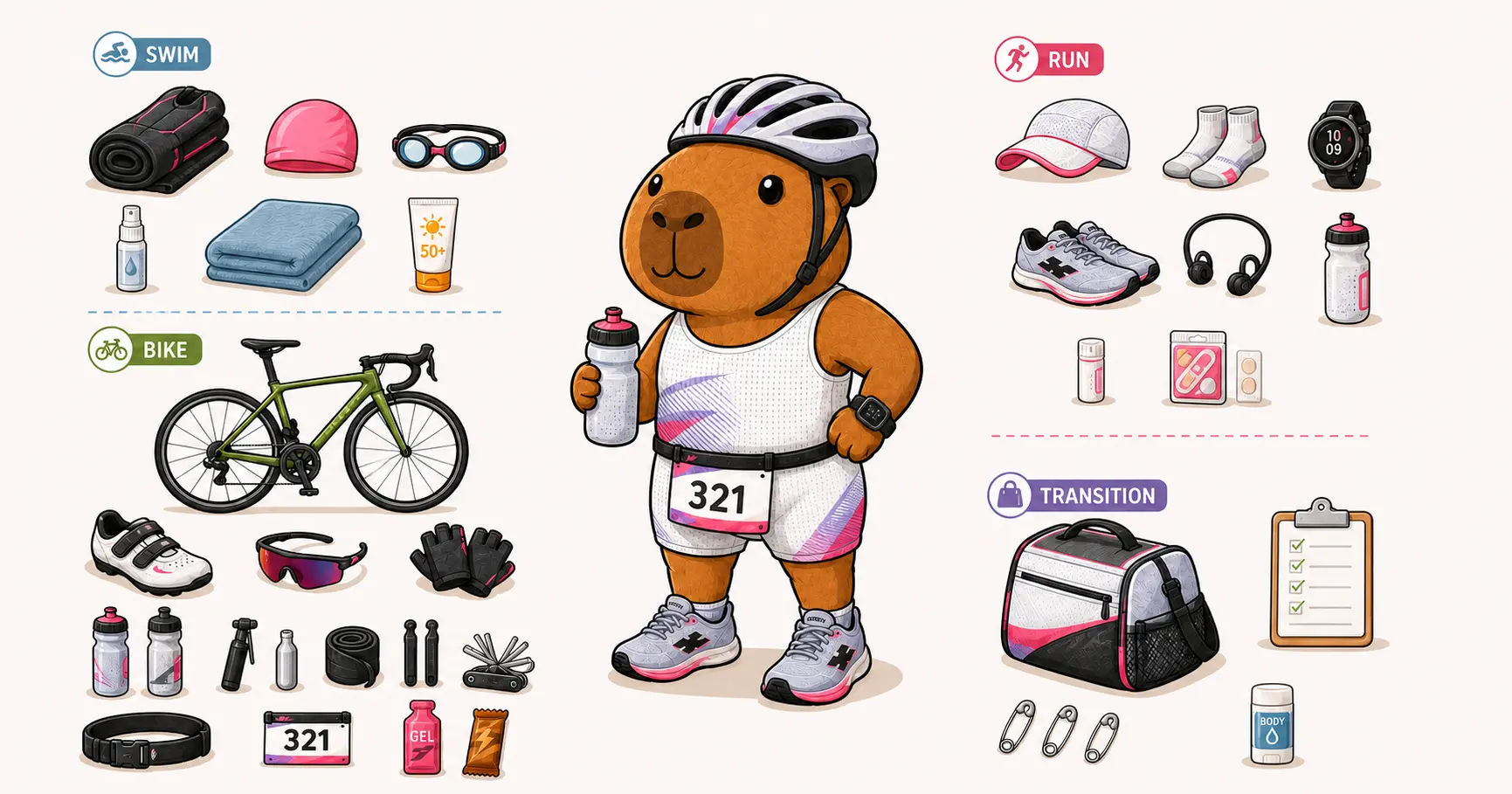
Here's the detailed list, phase by phase, aligned with the Trilalo app's checklist. Seven blocks, from the stickers you slap on the night before to the bag you find waiting for you past the finish line. It's the baseline, valid for every distance; we'll tune it for distance and weather in the sections below.
A complete triathlon checklist covers seven blocks: the night before (admin, electronics, nutrition), swim, bike, run, T1 bag, T2 bag and streetwear bag. Count on 25 to 40 items for a sprint, up to 60+ for an Ironman. Every item has a reason to exist, not a just in case— the sections below explain the “why” behind each one.
The night before (admin, electronics, nutrition)
Before you even think about the disciplines, you handle the admin and the invisible prep. The stuff that doesn't show on course but sinks your performance if you wing it.
- Race-bib belt + number. Belt with 3 attachment points, number pinned the night before (and crumpled for those looking for small gains 😉). Spin the belt in T2 (number on the back on the bike, front for the run).
- Timing chip — picked up at packet pickup and strapped to your left ankle. No chip, no time.
- Stickers. One on the bike, one on the helmet, one on the streetwear bag. On Half/Ironman, add the ones for the transition bags supplied by the race.
- Body marking — left arm and left leg if the race supplies tattoos. Apply to clean dry skin, the night before.
- Electronics charged to 100%. Watch, heart-rate monitor, bike GPS, Di2, power-meter pedals, cadence sensor. Plugged in the night before, not at 7 am.
- Bike course GPX — loaded onto the bike computer. Especially handy on long or technical formats.
- Race plan reviewed. Distances, aid stations, pacing strategy. Five minutes the night before saves a lot of in-race second-guessing — and keeps you from blowing up early in the run on the start-line buzz.
- Nutrition strategy defined — what you eat and when, by discipline. Written down somewhere, not stored in your head.
- Bottles, flasks, gels… Prepped the night before. Bottles filled, electrolyte flasks mixed, gels grouped by phase (bike, run).
- T1/T2 bags & streetwear — packed and zipped the night before, not in the morning. On Half/Ironman, you drop them at the race in the window assigned (often mid-to-late afternoon) and usually can't access them again; on sprint and Olympic, the bag just carries gear to the rack in the morning. Numbered stickers applied, contents checked in stacking order (first item used on top).
- Breakfast. Prepped the night before if possible, eaten at least 3h before the start. Nothing exotic: whatever you eat in training.
- Alarms set — at least two, on two different devices. At least 3h before the start, so you have time to eat, digest, and go to the bathroom.
Swim
Before you hit the water, layer up in this order: what goes on your skin first (chip, sensors, tri suit), then the wetsuit and swim accessories last.
- Timing chip. Strapped to your left ankle from the moment you arrive. It stays on your leg for the entire race. No chip, no time.
- HR strap + watch — heart-rate strap under the tri suit, watch on the wrist, both powered up and paired before you step into the water. No need to revisit them once the wetsuit is on.
- Tri suit. The base layer. Worn from the swim through to the finish line. Tuck a pre-start gel and a couple of tissues into the pockets for last-minute calls of nature on the start line.
- Compression sleeves (optional) — for those who wear them. Put them on before the tri suit and keep them on from start to finish — they aren't meant to come off in transition.
- Wetsuit. The wetsuit, for races where it's allowed. Slip it on 15 to 20 minutes before the start.
- Race-supplied swim cap — picked up at packet pickup, worn for the entire swim. In cold water, add a backup neoprene cap underneath.
- Swim goggles (×2). Always two pairs: one tinted for sun, one clear for overcast skies. If one breaks during warm-up, you have a spare.
- Anti-fog drops. A few drops in the goggles the night before. Don't bother relying on saliva — it won't last 1,500m.
- Warm-up resistance band — to fire up the shoulders in the transition area, before you hit the water. Five minutes of activation = a much less panicked start.
- Ear plugs. Optional but recommended in cold open water. They prevent the post-swim dizziness when you stand up out of the water.
- Anti-chafe lube. Neck (wetsuit collar) and armpits first. Without it, the wetsuit will saw into you by 800m.
- Wetsuit gloves — a huge time-saver if your wetsuit fits tight. Avoids ripping the neoprene with your nails.
Bike
- Bike serviced — mechanic visit at least a week out: brakes, derailleur, tires, chain cleaned and lubed. A flat you can handle, a broken derailleur you can't.
- Tire pressure + floor pump. Pumped to your target pressure the night before bike check-in, and the pump on hand race morning for one last top-up before racking, if needed.
- CPSC/CE-approved helmet. Buckled in T1 before you touch the bike. Racked in T2 before you touch anything else. Always.
- Bike shoes (+ rubber bands) — Time-saver: leave them clipped to the pedals, held flat with two thin rubber bands, and slide your feet in while rolling. Of course, don't try this on race day: if you haven't drilled it many times in training, put your shoes on in T1.
- Bike socks (optional). Depending on your transition strategy.
- Sunglasses — clip them upside-down onto the helmet, arms tucked into the vents. Grab them one-handed on the way out of T1.
- Bottle(s). Already filled, already clipped on the bike. On sprint, one is plenty; beyond that, plan at least for two.
- Energy gels + bars — in your bento box or taped to the frame with gaffer tape for easy reach on the bike. Test your nutrition in training, never on race day.
- Flat-repair kit. Saddle bag (or tool bottle) with: spare tube, tire levers, CO₂ cartridge + inflator (or mini-pump), multi-tool.
- Bike computer — charged to 100% the night before, not 60% “that'll do”. GPX of the course already loaded, sensors paired.
Run
- Running shoes. Ideally with elastic laces (or speed laces). On a 5K you save 30 seconds in T2; on an Ironman, it's just a relief on tired hands and legs.
- Running cap or visor — for the sun, the sweat, and a bit for the head. Critical on longer distances.
- Run socks (optional). On sprint, plenty go without. On half or Ironman, put them on — they prevent blisters.
- Electrolyte/isotonic flask — on half/Ironman, essential for managing sodium and carbs and avoiding cramps.
On half and Ironman, most race organizations hand out three color-coded bags (T1, T2 and streetwear) to drop off the day before — it's a widely known practice on full-distance events. On sprint and Olympic, you usually just have a single zone next to your bike, and in some cases a separate streetwear bag for after the race. The contents are the same in both cases; what changes is when you drop them off and where you find your gear on course.
T1 bag (swim → bike)
What you lay down in the transition area, ready to grab as you come out of the water. The order inside the bag matters: what you'll grab first goes on top.
- Towel. Small, for a quick foot wipe before sliding into bike shoes. Not a beach towel that hogs space in the zone.
- Rinse bottle / flask — a little water to rinse off feet (sand, grass) and grab a sip before heading out on the bike.
- Helmet + sunglasses. Sunglasses tucked arms-first into the helmet vents, grab both in one motion on the way out of the water.
- Race-bib belt + number — pinned the night before, belt clipped shut. On the bike, the number rides on your back; spin the belt in T2 to bring it to the front.
- Bike shoes. Either in the bag, or already clipped on the pedals (time-saving technique: slide feet in while rolling).
- Bike socks rolled inside-out — if you wear them. Inside-out = quick to pull on when your feet are wet. On sprint, plenty ride without.
- Talcum powder. A bit at the bottom of the bike (and run) shoes so your feet slide in despite the damp.
- Gels + nutrition. For the first minutes on the bike.
- Packable wind jacket — if it's raining or a cold start. Stuff it in the back of the tri suit as you leave.
- Trash bag / wet bag. For the soaked wetsuit, swim cap and goggles. Protects the rest of the bag from water.
- Sunscreen — on half/Ironman. Quick application before you head out, heavy on neck and forearms.
- Tissues. Two or three tucked into the tri suit. A cold, salt stinging your eyes, a sudden urge: you'll be glad you have them.
T2 bag (bike → run)
Simpler than T1, but it's where a lot of people lose time. Body's tired, brain's tired: this bag has to be even more readable than T1. Same prep approach the night before.
- Running shoes. Elastic laces loosened all the way, ready to step into in two seconds. It's the item you grab first, so it goes right on top of the bag.
- Run socks rolled inside-out — if you wear them. On half/Ironman, plenty wear them to avoid blisters; on sprint/Olympic, it's a choice.
- Running cap or visor. Sun, sweat and above all: fill it with ice at the aid stations in the heat, it'll drop your core temperature by several degrees.
- Electrolyte flask + run gels — the last nutrition window of the race. Top up the flask at an aid station if you need to, take a gel every 30–45 minutes.
- Anti-chafe lube. On half/Ironman, for the inner thighs, armpits and sometimes shoulders (bib strap, hydration pack). Three seconds in T2 save an entire marathon.
- Sunglasses — if different from the bike pair. Many keep the same; the case where you swap: aero lenses on the bike, more vented frames for the run.
Streetwear bag (after the race)
The bag you drop off in the morning and find waiting at the finish. It's also the one that gets forgotten the most: focus is on the race, the after gets neglected. Mistake. A bad post-race wrecks a good time.
- Warm dry clothes. T-shirt, hoodie, pants. The coast or the mountains cool you down fast after the effort, especially on half or Ironman.
- Open shoes. Birkenstocks, slides, flip-flops. Your feet are toast, you don't want to lace tight sneakers for the trip home.
- Bath towel — to dry off and change. Different from the mini T1 towel.
- Toiletries. Deodorant, soap, maybe shampoo if the race has on-site showers.
- Recovery drink. Down it within 30 minutes of the finish line, ideally with protein. Recovery nutrition starts there.
How to tune your checklist to the race distance
The baseline above is already comprehensive and fits most races. But the longer the distance, the more specific items you add: nutrition, aero gear, safety. Here's what each format demands on top.
| Format | Distances | Duration | Entry fee | Format-specific items |
|---|---|---|---|---|
| Sprint | 0.75 / 20 / 5 km | 30min–2h | $50–$100 | Half a bottle, 1 optional gel, flat kit optional |
| Olympic | 1.5 / 40 / 10 km | 1h30–4h | $100–$200 | 1 bottle, 2–3 gels, flat kit mandatory, aerobars recommended |
| Half / 70.3 | 1.9 / 90 / 21.1 km | 3h30–8h30 | $200–$500 | At least 2 bottles, 4–6 gels, electrolytes, T1/T2 bags dropped the day before |
| Ironman / Full | 3.8 / 180 / 42.2 km | 8h–17h | $700–$1,200 | At least 2 bottles, 6–10 gels, salt, “special needs” bag |
Sprint (~ 750m / 20km / 5km)
The discovery format: 1h to 1h15 of effort, entry $50 to $100. No aero gear needed, no complex nutrition strategy. Half a bottle, an optional gel, a pair of running shoes and you're set. The complexity of a sprint isn't in the gear, it's in the transition: every second counts at that distance. For the full first-race walkthrough (8-week plan, budget, stress management, race morning), see our first Sprint triathlon guide.
Olympic (~ 1.5km / 40km / 10km)
The benchmark format, around 2h15 to 3h of effort, entry $100–$200. At this level you bring at least one full bottle and one or two gels on the bike. The flat-repair kit becomes non-negotiable — 40km of road is plenty of distance to find glass. Aerobars stay optional, but plenty of racers add them from this distance on.
Half / 70.3 (~ 1.9km / 90km / 21.1km)
4h to 8h of effort, entry $200–$500 or more. This is where nutrition becomes its own discipline: at least two bottles, four to six gels, a bar, and ideally electrolyte tabs for sodium. On half, most races use a separate T1/T2 bag system, dropped off the day before — which means you usually can't add anything in the morning. The checklist becomes a precision instrument.
Ironman / Full (~ 3.8km / 180km / 42.2km)
8 to 17h of effort, entry $700–$1,200 or more. This is where nutrition gets complex: at minimum two bottles, six to ten gels, several bars, salt, sometimes a savory sandwich. The “special needs” bag (dropped at mid-course) becomes a topic in its own right. On Ironman, the checklist isn't a list anymore — it's a dossier.
“At my last triathlon, I left my run flask behind… sitting on the coffee machine.” — Arnaud
How to adjust for the weather
Weather changes the checklist. Conditions vary wildly between a high-altitude mountain race and a hot coastal Ironman like Kona. Pack to the forecast you have the night before — not the one you wish you had.
Cold-weather triathlon
Water below 16°C / 60.8°F: wetsuit becomes mandatory (see the World Triathlon rules in the previous section). Below 14°C / 57°F, add a neoprene hood and booties. On the bike, plan for arm warmers, full-finger gloves and a packable wind jacket (slip it on in T1).
Rainy triathlon
Rain changes two things: grip on the bike (you brake earlier) and dampness in your shoes. Also, if you rack the bike the night before, cover it with a trash bag (especially the electronics). Slip a plastic bag into each running shoe to keep them dry inside the T2 bag. Add some talcum at the bottom — it prevents blisters when wet feet slide around. Clear lenses on the bike, not tinted. On the run, keep the cap on: it insulates the head and keeps the rain out of your eyes.
Hot-weather triathlon
Above 28°C / 82°F, liquid nutrition becomes critical. Double the number of bottles (two on sprint/Olympic, three on half/full) and add salt tabs every 45 minutes. Cap mandatory on the run: fill it with ice at the aid stations, and you'll drop your core temperature by several degrees. Many races ban wetsuits above 22°C / 71.6°F, where the suit becomes a thermal trap.
If you have to drop your transition bags the night before, two reflexes: drop as late as the window allows (end of the day, when the sun is lower) and, above all, if possible, keep the nutrition with you until race morning. Gels, bars and salt tabs left in a closed bag in full sun become inedible: they melt, change texture, and wreck your stomach when you swallow them. Slide them into the bags at the last minute, in the morning, right before racking.
How to organize your T1 and T2 bags
Transitions aren't dead time. As Triathlete points out, on the shorter distances transitions can swallow several minutes — enough that USA Triathlon calls them the fourth discipline of triathlon. On a sprint, losing 30 seconds at the rack can be the difference between standing on the age-group podium or not. Golden rule: stacking order = pickup order. The first object you'll need goes on top. The last one all the way at the bottom. Sounds obvious, but the shaky hands you bring out of the water don't rummage — they grab.
Before that, you need to know what kind of setup you're racing in. Two systems coexist in triathlon: single zone on sprint and Olympic (everything sits next to the bike, one spot), and separate T1 & T2 bags on half and Ironman, for example, where on full-distance events race organizations almost always supply three codified bags (T1, T2, streetwear) dropped off the day before (IRONMAN 70.3 Athlete Guide). Questions to ask yourself before filling a bag:
- Do you come back to the same rack after the bike?
- Are there one or several bags to drop off before the race?
- Do volunteers move or hang the bags?
- What do you need to put on, and what do you need to take off, at each stage?
The answers live in the athlete guide sent by the race organization, usually one to two weeks before the race.
A few concrete rules for both bags: never mix T1 and T2, even with one big bag — separate them physically inside (two compartments or two pouches). The helmet sits open on the bike (or in the T1 bag if the race supplies it), not closed: your head slides in in two seconds. The race belt is clipped shut, the bike and run shoes are loosened up to slide on fast in transition.
On half and Ironman races with bag drop the night before, you usually can't access your gear in the morning. Triple-check, then drop. And keep a mini-bag with you for the morning with the bare minimum: wetsuit, goggles, cap, pre-start gel.
How to organize your pre-race
The right gear is useless without controlled timing. Here's the chronology experienced triathletes recommend, to adjust to your start time. The point isn't to stick to the timeline to the minute — it's to have a frame that prevents tasks piling up in the morning.
This timeline mostly fits sprint and Olympic — where bike and T1/T2 gear are dropped on race morning. On half and Ironman, race organizations often require a drop-off the day before in the mid-to-late afternoon, which shifts the rhythm: packet pickup earlier, briefing, bike check-in, then carb-loading dinner.
The day before (D-1)
It all happens before 9 pm. Pick up your bib and scout the T1/T2 zones. Simple carb-rich dinner at 8 pm (pasta, rice — nothing exotic, and definitely no fiber), T1 and T2 bags packed and zipped by 9 pm. The bike gets one last pass: tire pressure, derailleur, number affixed. Lights out by 10 pm. The night before a race rarely sleeps well, so don't shorten it. Before you sleep, visualize your transition three times (the first buoy, the swim exit, helmet clipped, bike racked) — Triathlete coaches treat that kind of mental rehearsal as the cheapest way to cut down on race-day transition errors. Three minutes of mental rehearsal beats a sleepless night spent overthinking.
Race morning
Wake up at least 3h before the start, so you have time to eat a real breakfast, digest, and above all go to the bathroom (sensitive subject). Get to the venue 1h15 before your start: rack the bike, set up your transitions, scout your spot relative to the swim exit. Short warm-up (5min jogging + a few strides), gel 15 min before the start, and step into the water for 5 minutes of easy swimming before the line. You arrive at the start warm, hydrated, calm.
The 7 mistakes to avoid
The classics. We've all made them at least once. The good news: a solid checklist sidesteps all of them.
- Packing the bag on race morning. The worst mistake. In the morning, your head is on the race, not on the logistics. Recipe for forgetting something for sure.
- Skipping the mental rehearsal of your transitions. Once you're in the race, you don't have the clarity left to remember the right moves to be efficient and not forget anything. It has to be automatic — you shouldn't be thinking when you hit transition.
- Testing nutrition on race day. New gel never tried = wrecked stomach 30km into the bike. Everything you eat in a race has to have been tested in training.
- Forgetting to charge the GPS / power-meter pedals. 5% battery at the start of a half = no data on the bike. Charge to 100% the night before.
- Wearing the bib in the wrong spot. On the belt: back on the bike, front on the run. Spin the belt out of T2, don't think about it again.
- Waking up too late. You need to wake up at least 3 hours before the race so you can eat and digest, but most importantly have time to go to the bathroom. The sooner that's off your plate the better — and it's often complicated on site.
- Trying to keep everything in your head. Your brain isn't built to store 30 items the night before a race. That's exactly what a checklist is for.
With Trilalo, less mental load.
More calm.