You've just clicked on “Confirm registration” for your first Sprint triathlon. And then, the doubt creeps in. How long to train? What gear to buy, what gear to borrow? What actually happens on race morning? In 2025, USA Triathlon counted more than 303,000 unique active members (USA Triathlon, 2025 Impact Report, retrieved May 20, 2026), and the vast majority started with a Sprint triathlon. Not with an Ironman.
This guide pulls together everything we wish we'd read before our own first race bib: a realistic training plan, an honest budget, stress management, useful tips, and the minute-by-minute breakdown of race day. Everything you need to cross the finish line without losing sleep over three hundred unanswered questions the night before.
How long does it take to prepare for a first Sprint triathlon?
Eight weeks. That's the plan most coaches recommend for a beginner who can already swim there and back without drowning and run 3km without stopping. According to Triathlete.com's 8-week Sprint plan for beginners (retrieved May 20, 2026), a beginner plan fits in 5 to 6 hours of weekly training, spread over 5 days with 2 rest days.
If you're starting from further back (not a swimmer, limited cycling or running), bump it up to 10 to 12 weeks. The goal of the first two weeks shifts: before you build endurance, you build comfort: crawl 100m breathing easily, hold 25 minutes of run/walk intervals, get comfortable on the bike, and ride 1 hour without stopping.
Here's one way an 8-week plan can break down, in four phases:
- Weeks 1-2, aerobic base. You start with three easy sessions per discipline. Technical swimming (drills, no clock), 45-minute bike rides at conversational pace, 25 to 30 minutes of easy aerobic running.
- Weeks 3-4, discovering the brick. You introduce the bike-run brick (one brick per week, 30 min bike + 10 min run). Your legs learn that cotton-leg sensation at the start of the run.
- Weeks 5-7, ramping up. You extend the bike rides (up to 1 hour 15 minutes), add pickups on the run (4×1 min fast, 1 min slow), and squeeze in at least one open-water session in a lake or the sea to test sensations and learn to sight.
- Week 8, taper. You cut volume by 30%, but keep intensity. The final week, just two short sessions, rest, and a test brick five days out to dial in the bike-run transition.
The non-negotiable session, in every plan: the brick (bike-run combo). It's the session that specifically prepares the T2 transition, the place where beginners most often fall apart: the first 500 meters of the run.
What gear do I need for a first Sprint triathlon?
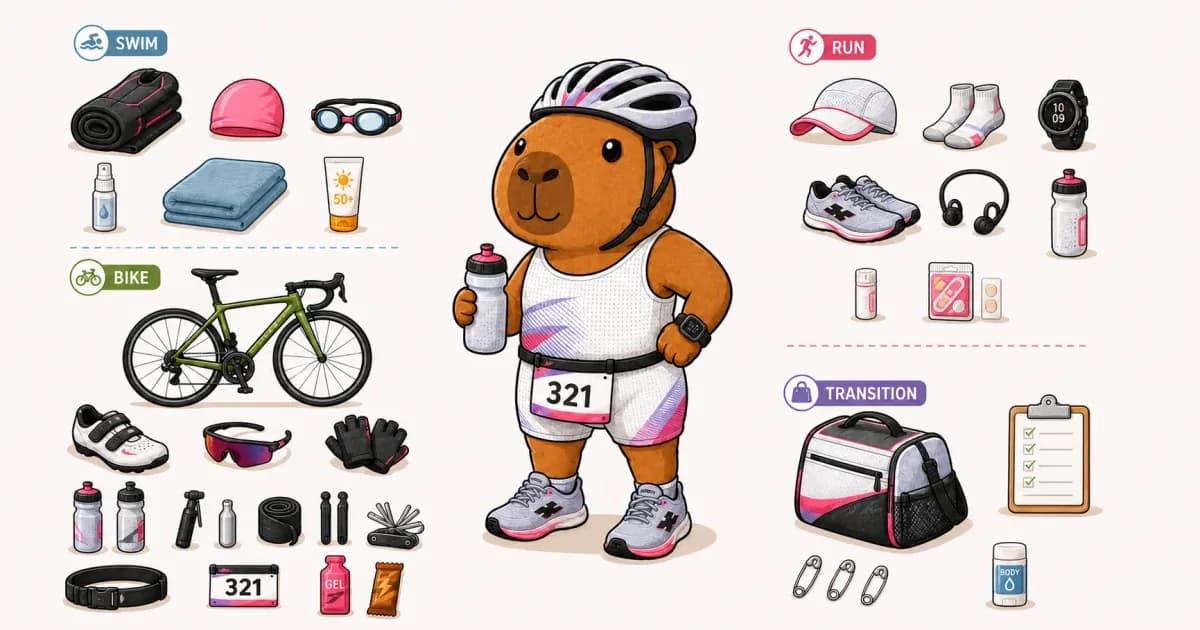
The bare minimum fits in eight items:
- A tri suit
- A swim cap
- Goggles
- A working bike
- A CPSC-approved helmet
- A pair of running shoes
- A race-bib belt
- A race number provided by the organization
According to the USA Triathlon Multisport Competition Rules (retrieved May 20, 2026), only the helmet and the race number are strictly mandatory on the gear side.
No aero bike needed, no clip-on bars, no wetsuit if the water is above 78°F (USAT's wetsuit-optional cutoff). For the full item-by-item list, T1 bag, T2 bag and streetwear bag, check out the complete, USAT-compliant gear checklist. It covers everything to plan for, by discipline and by distance.


How much does a first Sprint triathlon cost?
Between $300 and $500 all-in if you play the used market or borrow from friends. Triathlete.com's “15 Must-Haves: Essential Beginner Tri Gear” (retrieved May 20, 2026) sets the right mindset: the kit doesn't make the athlete; comfort and budget control come before the marketing. On the numbers side, Triathlete.com's “Triathlon Doesn't Have To Be Expensive” (retrieved May 20, 2026) reminds us that wetsuits are often rented per race, and used bikes start under $500. Borrow the bike and rent the wetsuit, and you easily slip under $300.
| Item | Range | Note |
|---|---|---|
| Used bike (road or hybrid) | $250-500 | Borrowed from a friend: $0. |
| CPSC-approved helmet | $30-60 | USAT mandatory, preferably new. |
| Tri suit | $40-90 | An entry-level tri suit is enough to get started. |
| Goggles + swim cap | $15-30 | Race-day cap is very often supplied by the organization. |
| Running shoes | $0-100 | You go with the pair you already own. |
| Race-bib belt | $10-25 | Keeps the bib on your back for the bike, then rotates to the front for the run. |
| Entry + USAT membership | $75-150 | One-day Bronze $13 (Sprint), Silver annual $69.99. |
| Nutrition (prep + race day) | $30-60 | Gels, electrolytes, recovery drink, tested in training, never on race day. |
Three things can balloon the bill: a wetsuit (between $80 and $150 used) if the water is cold, a GPS watch (from $50) if you want one, and travel plus lodging if the race is far away. None of these three is required to finish a Sprint.
Nutrition: the line item people underestimate
It's not a comfort spend, it's a training tool. As USA Triathlon's “Establishing Your Race Nutrition Plan” (retrieved May 20, 2026) reminds us, beyond one hour of effort, carbs (sports drink or gels) become necessary every 30 minutes. Across 8 weeks of prep, that's 5 to 10 gels, two or three packets of sports drink, and a recovery drink, roughly $5 per long session, plus 2 or 3 gels on race day. Total: $30 to $60. And above all: test everything in training, never on race day.
How do I manage first-start-line stress?
The stress of a first triathlon isn't a prep failure, it's a normal physiological response. The anxiety usually comes from the mass start and the swim more broadly. The rule, shared by most coaches and experienced triathletes: you don't fight stress, you channel it. Four concrete tactics, all following the same small-steps logic (one objective at a time, not the whole race at once):
Box breathing
Four seconds inhale, four seconds hold, four seconds exhale, four seconds hold. Do it for a few minutes sitting by the water, right before warm-up.
The “first buoy” framing
You don't think about the finish line, you don't think about the bike, you don't even think about the swim exit. You think only about reaching the first buoy calmly, by deliberately positioning yourself at the back or on the outside of the pack, away from the line to the first buoy, while settling into your stroke. Once past the first buoy, the water often opens up and your brain finds its calm again.
Visualization
Three times the night before, lying in bed, you mentally walk through both transitions. You exit the water, peel off the top of the wetsuit while running, then the bottom on arrival at T1, then clip on the helmet, slip on the race belt, and so on. The brain doesn't distinguish between living the scene and visualizing it: on race day, the movements come out automatically.
The goal: reach the line, no clock target.
For a first triathlon, you don't chase a time, you chase three objectives: finish the swim without panicking, pace yourself on the bike to keep energy for the run, and cross the finish line uninjured and with a smile. Three objectives for a successful race, whatever the final time says.
What happens on race day?
Race morning actually starts 24 to 48 hours earlier. Four things get locked in before the 5:00 a.m. alarm, without which race day already kicks off in panic mode:
- Pick up your race number. Packet pickup almost always happens the day before. Without your number, stickers and timing chip in hand on time, no start.
- Attend the briefing. The briefing usually takes place during packet pickup. You sit in to learn the race-specific rules (gear allowed/banned, penalties), get an overview of the course and its tricky spots, and pick up the organizers' final tips.
- Recon the bike course. Essential if there are one or more climbs, a technical corner or a serious descent. A short ride on-site a few days out, at easy pace, to memorize the route and where to brake can be a real asset on race day.
- Pack your transition bags at home, in a calm setting, not at 5 a.m. in the dark with shaky hands. Item-by-item detail in our T1 and T2 transition bags checklist.
- Charge your electronics (watch, bike GPS, power meter, etc.). All plugged in the night before: a dead device at 7 a.m. means racing without pacing and without a reference time.
Race day itself fits in an eight-step timeline spread over three hours before the start (using a hypothetical 8:00 a.m. start as an example). As USA Triathlon's “Tip Top Transition Tips” (retrieved May 20, 2026) points out, the transition is often called the “fourth discipline” of triathlon, that's where beginners lose the most time, and the most clarity.
- 5:00 a.m., wake-up. Simple carb-based breakfast (white bread, honey, coffee, or whatever you're used to eating). No fiber, nothing exotic. You've eaten this exact meal ten times in training.
- 5:30 a.m., getting ready. Timing chip strapped to the left ankle, watch on wrist, anti-chafe lube applied, tri suit on.
- 6:00 a.m., leaving for the venue. Bags checked one last time, bike in the car. Leave with 15 minutes of slack on the drive: packed parking or a traffic jam near arrival is common.
- 7:00 a.m., setting up in transition. Reminder: to enter the transition zone, your helmet must be buckled and your race-bib belt on (number fixed with 3 attachment points). Once at your spot: rack the bike by the saddle, handlebars facing you. Set the open helmet on the handlebars with the goggles inside. The race belt should be ready to slip on quickly, with socks, bike shoes (if different from your running shoes), and running shoes laid out next to it, loose.
- 7:20 a.m., recon. You walk to the swim exit, count the rows so you can find your spot without hesitation. You scout the bike-out and run-out exits of the transition zone.
- 7:35 a.m., warm-up. Five minutes of very easy jogging, a few pickups, shoulder mobility. Wetsuit on if allowed.
- 7:45 a.m., into the water. A few minutes of easy swimming to get your face used to the cold water, trigger the dive reflex, and test the goggles. Gel taken 15 minutes before the start.
- 8:00 a.m., start line. You position yourself at the back or on the side, breathe three times slowly, eyes on the first buoy. And you're off.
How does a triathlon transition zone work?
On Sprint and Olympic (M) formats, in the vast majority of cases, the transition zone is a single one: everything happens in the same place, twice. You come back to it leaving the water (T1, swim → bike), then again when racking the bike (T2, bike → run). Each athlete gets an assigned spot on the bike rack; the rack number almost always matches the race number.
Next to the bike, you lay down a small towel that serves as a mat and a visual marker. Gear lines up in order of use:
- Open helmet, goggles tucked into the vents, first move after the swim.
- Race-bib belt closed with the number, set inside the helmet, you slip it on by stepping through the leg holes in T1, number on the back for the bike and on the front for the run.
- Socks rolled inside-out so they slip on quickly.
- Bike shoes loosened on the ground (or already clipped to the pedals if you can put them on while riding).
- Running shoes with loose elastic laces, placed behind the bike shoes, first move after the bike.
- Cap, hat or other accessory to dial in based on the weather (rain, cold, heat).
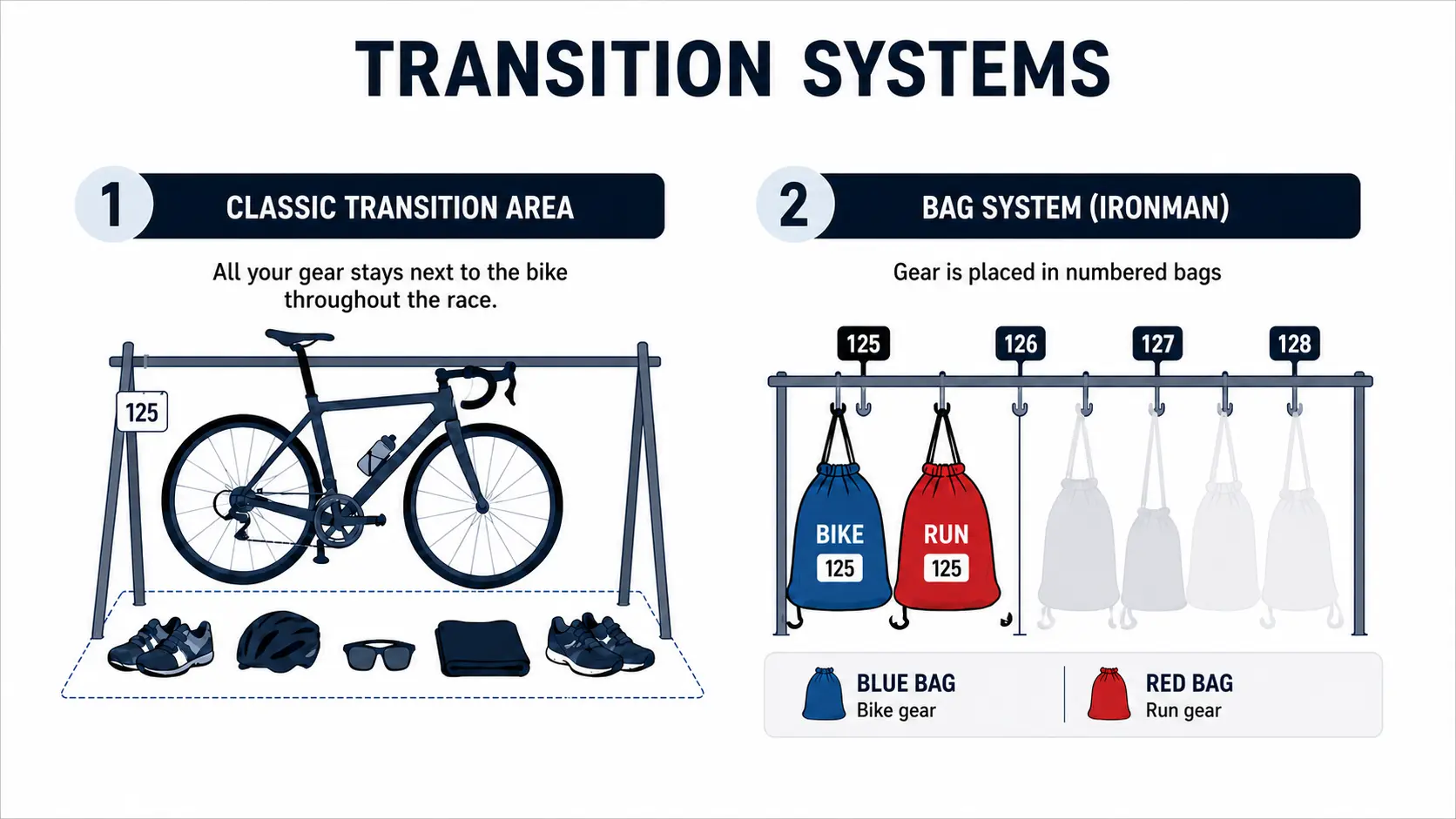
Alongside all that, a third bag lives apart: the streetwear bag. That's the one you drop off in the morning before the start, at bag check (almost always identified by a sticker with your race number), and pick up again after the finish. Inside: warm and dry clothes, flip-flops or slip-ons, a towel, recovery drink and toiletries. You don't bring it into the transition zone, it stays at bag check for the whole race.
On Half and Ironman, the system changes completely: T1, T2 and streetwear bags are dropped off the day before, and the transitions can be separated by several hundred meters. For those formats, switch to the checklist adapted to each distance.
What are the typical mistakes on a first triathlon?
Beginner mistakes are surprisingly predictable. They show up on almost every first race. Knowing them in advance is already half the battle.
- Skipping the anti-chafe lube. Apply on the neck (wetsuit collar) and armpits first. Without it, the wetsuit or tri suit can saw into you and derail the race.
- Starting the swim too fast. Adrenaline and kicks from neighboring swimmers send your heart rate through the roof. After 200m, you're gasping. You start deliberately below your training pace for the first 100 meters, working to settle your stroke and keep heart rate in check.
- Forgetting to buckle the helmet before touching the bike. Non-negotiable USAT rule: helmet on, chin strap closed, before any contact with the bike in T1. A single second of forgetfulness can mean a time penalty or even disqualification.
- Forgetting to put on the race-bib belt or to keep the timing chip in place. The belt goes on with the number on your back for the bike, then rotates to the front for the run. The timing chip stays on your left ankle from start to finish, a small detail that becomes critical when you pull on socks in T1 or T2.
- Mounting the bike before the mount line. The line on the ground at the transition exit isn't decorative. You push the bike walking to the line, then mount. Otherwise: penalty.
- Not fueling enough. A Sprint race lasts 1 to 2 hours, short enough that you think you can skip it, long enough to crater mid-race when your legs start to feel heavy. Carb-based breakfast, one gel 15 minutes before the start, and a bottle of electrolytes on the bike. In hot weather (above 77°F), double the electrolytes and add a gel in T2 or early in the run: without it, cramps or a bonk are almost guaranteed at km 3 of the run.
- Trying a gel you've never tested in training. The stomach doesn't like surprises. An unknown gel taken 30 minutes into the race can mean a forced stop somewhere on the bike course. You eat in racing what you ate (and tolerated) in training.
- Starting the run too fast. Exit T2, legs feel floaty, the brain thinks you can empty the tank. Five hundred meters later, you're walking. Start 15 to 30 seconds per kilometer slower than your target pace, then pick it up after 1 or 2 kilometers if the legs respond.