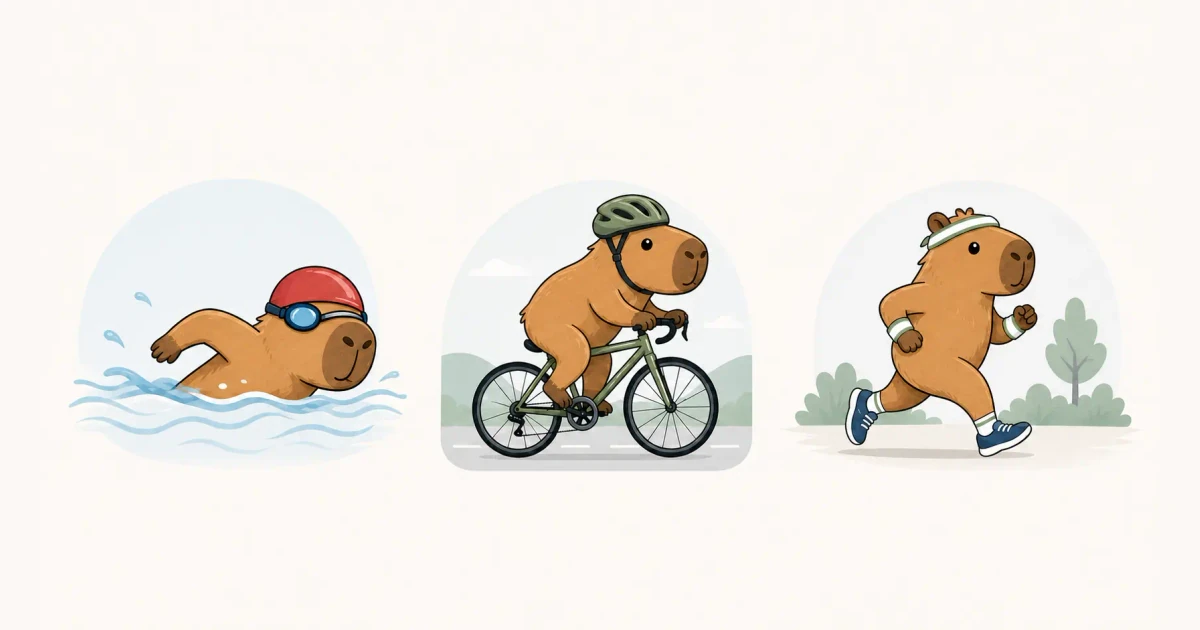
A sprint triathlon is a 750 metre swim, a 20 kilometre bike and a 5 kilometre run, raced in that order, with two timed transitions in between. That single line answers most searches on this subject. The rest of this page answers the question underneath it: which distance should you actually sign up for, and what does each one ask of you?
Federations publish the numbers. What they rarely publish next to them is how long each format takes, why the names contradict each other, and what changes in your bag between one and the next. That is what follows.
Every triathlon distance, side by side
| Format | Swim | Bike | Run | Typical finish |
|---|---|---|---|---|
| Super sprint | 400 m | 10 km | 2.5 km | 35 min to 1 h |
| Sprint | 750 m | 20 km | 5 km | 1 h to 2 h |
| Olympic (standard, M) | 1.5 km | 40 km | 10 km | 2 h to 4 h |
| Middle (70.3, half, L) | 1.9 km | 90 km | 21.1 km | 3 h30 to 8 h30 |
| Long course | 2 km | 80 km | 20 km | 4 h to 8 h |
| Full (Ironman, XL) | 3.8 km | 180 km | 42.2 km | 8 h to 17 h |
Distances follow the World Triathlon standard formats (supertri format reference, retrieved 12 September 2026). Finish times are indicative ranges for age-group athletes across a whole field, not targets: the course profile and the swim conditions move them more than anything else.
Sprint triathlon distances, the format most people start with
750 m swim, 20 km bike, 5 km run. Around an hour of racing for a fast age-grouper, closer to two for a first-timer who takes the swim carefully. It is the format that made triathlon accessible, and the one nearly every triathlete started with.
Two things surprise people at this distance. The first is that the swim is short enough that technique matters more than endurance: 750 m in open water with 200 other people is a different exercise from 750 m in a lane. The second is that transitions are a real part of the result. On a race that lasts 90 minutes, spending four minutes in T1 instead of ninety seconds costs you more places than a whole training block would win back.
Watch out for local variants. Some events sell a “sprint” that is 500 m / 20 km / 5 km, others run an XS at 400 m / 10 km / 2.5 km and still call it a sprint on the poster. The fact sheet on the race page is the only distance that counts.
Super sprint, olympic, middle and full
Super sprint (400 / 10 / 2.5). The gentlest way in, and a genuinely good idea if what worries you is the open-water swim rather than the fitness. Under an hour, often raced in waves, frequently the format used for first-timer waves at bigger events.
Olympic, also standard or M (1.5 / 40 / 10). Roughly double the sprint, and the point where pacing starts to matter: go too hard on the bike and the 10 km will tell you about it. Nutrition becomes a real decision here, one bottle and two or three gels rather than nothing at all.
Middle distance, also 70.3, half or L (1.9 / 90 / 21.1). Half a day of racing, and in practice a different sport: what you eat on the bike determines whether you run or walk the half marathon.
Full, also Ironman or XL (3.8 / 180 / 42.2). Eight to seventeen hours. The logistics become a project of their own: special needs bags, a nutrition plan rehearsed in training, and equipment checked the way you would check it before a long trip.
Long course (2 / 80 / 20). The World Triathlon long distance sits between the middle and the full, and you will meet it far less often than the others because the commercial series do not use it.
How long each distance actually takes
The honest answer to “how long does a sprint triathlon take” is 1h15 to 1h45 for most age-group athletes, with a full field spreading from roughly an hour to a little over two. That spread is not mostly fitness. It is the swim conditions, the profile of the bike course, and how much time disappears in the two transitions.
Which makes the question “what is a good sprint triathlon time” less useful than it sounds. On these distances the gap between the front and the back of a field is regularly more than an hour, and a single fumbled transition moves you several places. For a first race, under 1h45 is a solid result for someone who has trained 5 to 6 hours a week for a couple of months. For the second one, the number worth beating is your own.
One thing that catches everyone out the first time: the clock does not stop between disciplines. T1 and T2 are timed, they appear in your official splits, and they are the cheapest minutes you will ever save.
Why the names do not match the numbers
Three naming systems overlap, and nobody warns you. Federations classify formats by size: XS, S, M, L, XL. World Triathlon uses descriptive names: super sprint, sprint, standard, long distance. Commercial organisers use brands: Ironman and 70.3, where 70.3 is simply the number of miles in the half format.
So the same race can legitimately be called an M, a standard, or an olympic, and the 1.9 / 90 / 21.1 format is a L, a half, a middle distance or a 70.3 depending on who printed the page you are reading. The distances are stable; only the vocabulary moves. When two sources seem to disagree, they are almost always using different systems rather than different numbers.
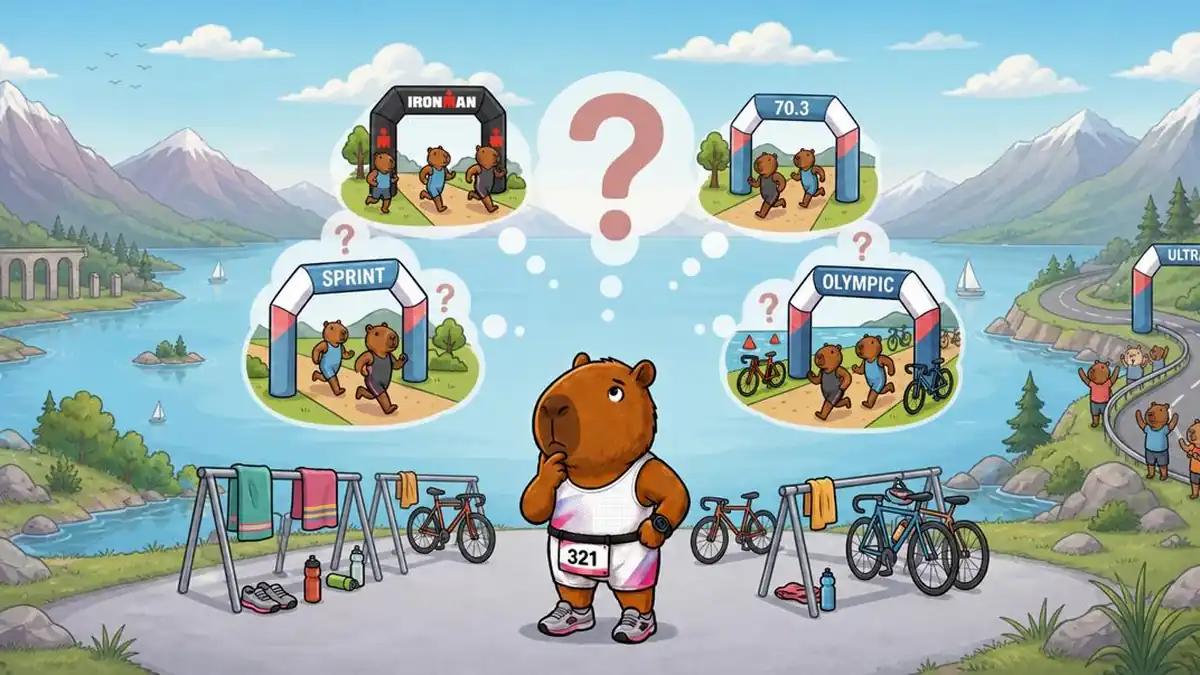
Which distance for a first race
Sprint, unless the swim is what worries you, in which case super sprint. The reasoning is not about ambition, it is about what you can prepare for without rearranging your life: eight weeks at five or six hours a week gets you to a sprint start line, entry fees are the lowest of any format, and the bike you already own is good enough. A road bike, or a well-maintained hybrid, will get you round 20 km perfectly well.
Going straight to an olympic is possible if you already run or swim seriously. Going straight to a middle distance rarely ends well, not because of the fitness but because the logistics and the nutrition are learned, and a first race is a bad place to learn them.
And the distance is only half the question. Two races at the same format are not the same race: look at the elevation gain on the bike and on the run, and find out what the swim conditions are, sea or ocean against lake or river. A flat olympic swum in a lake and a hilly olympic starting in choppy sea ask for neither the same preparation nor the same kind of athlete. Choose against what you have actually trained for.
If you want the detail of how to get from signing up to the start line, our complete guide to a first sprint triathlon covers the training plan, the budget and the race-morning timeline.
What changes in your kit between distances
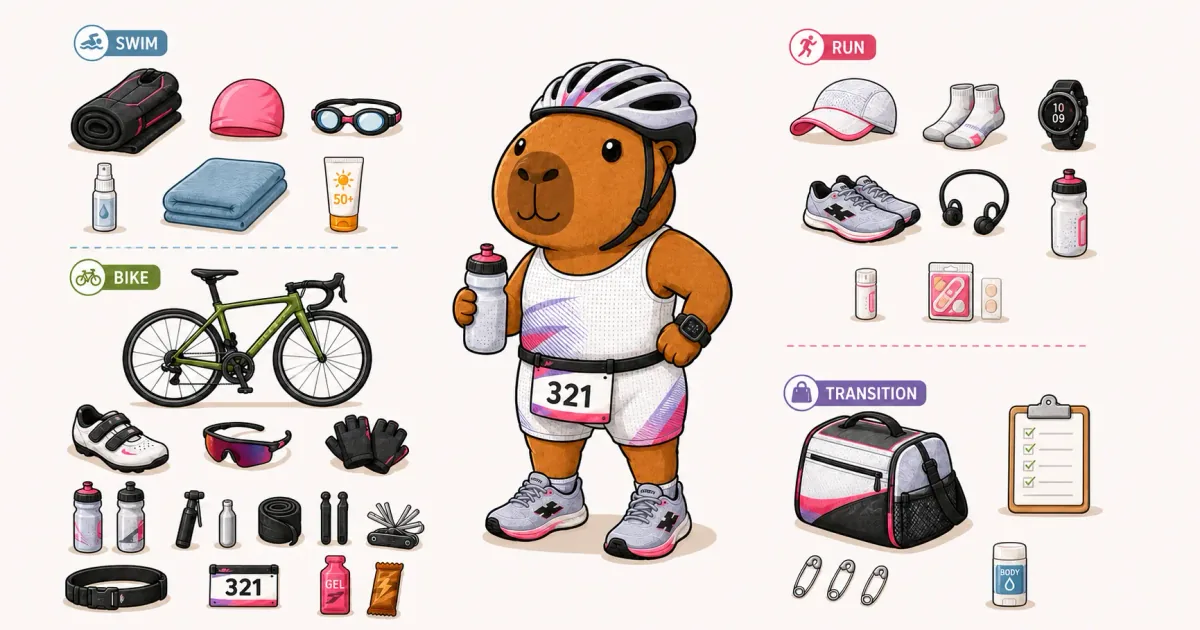
Less than people fear, and not where they expect. The three disciplines need the same things at every format: a wetsuit or swimsuit, goggles, a helmet, a bike, running shoes, a race belt. What the distance changes is the nutrition and the transition logistics.
- Sprint: half a bottle, one optional gel, a flat kit if you want peace of mind.
- Olympic: one bottle, two or three gels, a flat kit is no longer optional.
- Middle: at least two bottles, six to nine gels, electrolytes, and separate T1 and T2 bags.
- Full: ten to fifteen gels, a special needs bag, and a plan you have rehearsed rather than improvised.
The item-by-item version, by discipline and by weather, lives in our complete triathlon checklist. Or let the app build the list for your distance, your disciplines and the forecast, in about two minutes.